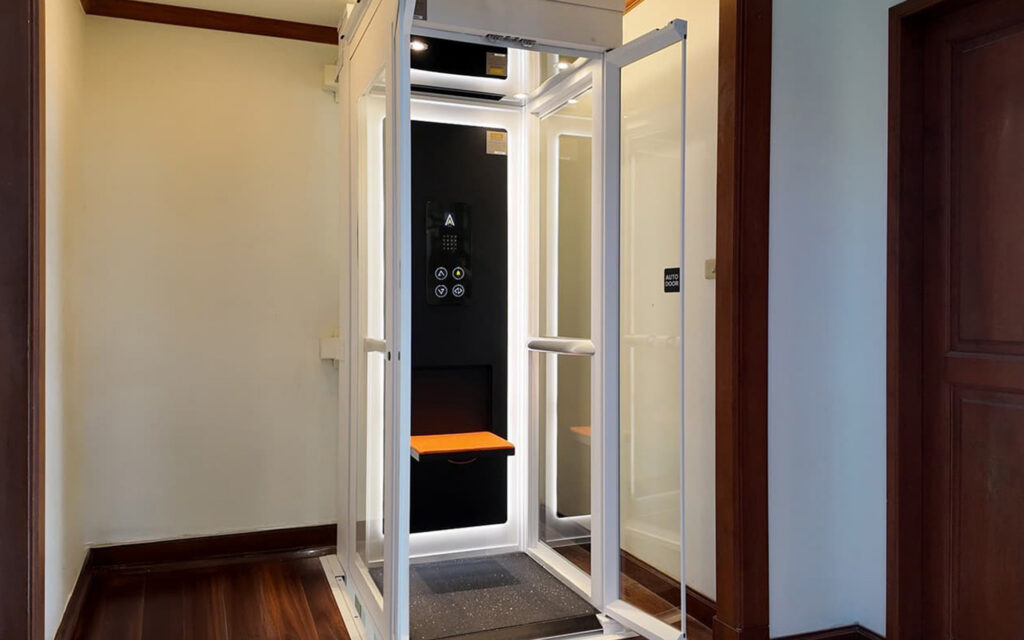
If you’ve searched for home elevator cost or house elevator cost online, you’ve probably found three different answers on three different websites, and none of them account for the kind of home you actually live in. A 1920s farmhouse outside Ithaca and a new-build ranch in the Syracuse suburbs don’t retrofit the same way, and most national pricing guides don’t say so. Here’s what a home elevator actually costs by type, what pushes that number up or down in an Upstate New York home, and two New York-only ways to bring your real number down.
What Home Elevator Cost Looks Like, by Type
Home elevator cost breaks down almost entirely by which type you choose, since each one asks something different of your home’s structure.
| Elevator Type | Installed Cost Range | Construction Required |
| Shaftless / through-the-floor (Stiltz, Symmetry) | $45,000–$80,000 | Floor cut-out only, no shaft or pit |
| Hydraulic / traditional | $38,000-$50,000 | Hoistway and typically a pit |
Shaftless and Through-Floor Elevators
A shaftless elevator, like the Stiltz and Symmetry Elevating Solutions models we install, travels through a cut-out in your floor instead of a built hoistway, which is what keeps the price down. Installed cost typically runs $35,000 to $60,000, and most of that number is the unit itself rather than construction, since there’s no shaft, pit, or dedicated machine room to build. It plugs into a standard 220-volt outlet and can usually go in within a matter of days once site prep is done. For homeowners comparing shaftless elevator cost against a full hydraulic build, this is often the lower-cost path to the same result.
Hydraulic and Traditional Elevators
A hydraulic elevator uses a piston and a sealed cylinder to move the cab, and it needs a hoistway and typically a pit, which adds real construction cost on top of the equipment. Installed pricing generally runs $40,000 to $75,000 or more in this region, with the wide range coming almost entirely from how much building the home requires. Older Upstate New York housing stock, farmhouses, split-levels, and homes with additions built at different points, often needs more site work than a newer build with open floor plans, and that shows up directly in the final number. Homeowners planning new construction can often build the hoistway into the framing from the start, which brings the cost down significantly compared to retrofitting it later.
What Drives the Cost Up or Down in an Upstate New York Home
The type of elevator only sets the starting range for home elevator cost. Inside that range, a handful of factors decide where your specific project lands, and most of them come down to what your home already offers and what it doesn’t.
Retrofit vs. New Construction
Adding a home elevator to a house that’s already built almost always costs more than planning for one during new construction, sometimes by tens of thousands of dollars. Retrofitting means opening a floor, running new electrical to code, and in some cases reinforcing framing to carry the added weight, all before the elevator itself goes in. If you’re building new or doing a major addition anywhere in the Syracuse, Rome, Utica, or Finger Lakes area, framing the shaft or floor opening into the plans from day one is the single biggest way to control cost.
Number of Stops and Cab Finish
Every additional floor a home elevator needs to reach adds to both the equipment cost and the installation time, so a two-stop elevator serving a basement, main floor, and second floor costs more than a single-stop unit. Cab finish matters too. A standard finish keeps the project closer to the lower end of the range, while wood paneling, glass panels, or a custom color and lighting package can add several thousand dollars. None of this needs to be decided before you get a quote, but knowing it going in makes the number you’re given easier to understand.
Two New York-Specific Ways to Lower the Real Cost
National pricing guides almost never mention this part, because it doesn’t apply outside New York. Two state-level programs can meaningfully change what you actually pay.
The NY Sales Tax Exemption on Capital Improvements
A home elevator installation qualifies as a capital improvement under New York tax law, which means it’s exempt from state and local sales tax when the paperwork is filed correctly. That exemption is claimed with a Certificate of Capital Improvement, form ST-124, completed by your contractor at the time of installation. On a $40,000 to $60,000 project, skipping that step and paying sales tax anyway can mean handing over several thousand dollars you didn’t need to spend.
The Access to Home Program
New York State’s Access to Home Program, administered through Homes and Community Renewal, funds accessibility modifications, including lifts, for income-qualified homeowners living with a disability. The program runs through local program administrators rather than a single statewide office, and active funding has supported projects in counties across our Upstate NY service area, including Broome, Chenango, Cortland, Tompkins, and Erie. Eligibility and available funding change by county and by year, so it’s worth checking current availability with a local administrator before you assume it applies to your situation, but it’s a resource almost nobody researching home elevator cost on their own ever finds.
The Full Investment, Not Just the Install
How much does a home elevator cost once it’s actually running, not just installed? The number everyone focuses on is the install price, but it isn’t the whole picture.
Annual Maintenance and Upkeep
Plan on a maintenance visit once or twice a year, typically running $200 to $500 per visit depending on the elevator type and what needs servicing. Shaftless elevators tend to need less upkeep than hydraulic systems, since there’s no hydraulic fluid to change and fewer moving parts overall. Occasional part replacements, things like door sensors or switches, generally run $150 to $1,000 depending on the part. Building this into your budget from the start means there are no surprises five years in.
What It Adds to Your Home’s Value
A home elevator isn’t purely an expense. In multi-level homes, especially ones where a future buyer might want to age in place, an elevator is a real selling point rather than a quirky feature, and industry data from the National Association of Home Builders points to measurable value gains in markets where accessibility features are in demand. It’s not a dollar-for-dollar return, but it’s a meaningful offset against the upfront residential elevator cost that most buyers don’t factor in.
Home Elevator Cost vs. the Cost of Moving
For a lot of homeowners, the real comparison isn’t home elevator cost against zero, it’s home elevator cost against the cost of selling a house you love, buying a new one, and moving. Realtor fees, closing costs, and the disruption of relocating often add up to more than a home elevator installation, especially for homeowners who’d otherwise be perfectly happy staying exactly where they are. Framed that way, the number stops looking like an indulgence and starts looking like what it actually is, a practical way to stay in the home you’ve already built a life in.
Get a Real Number for Your Home
Every range in this article is a starting point, not a quote, because the honest answer to what a home elevator costs depends on your specific house, your floor plan, and what you’re hoping to get out of it. That’s the piece a national pricing guide can’t give you, and it’s the piece that actually matters when you’re deciding whether this makes sense for your family.
Access Lifts has been installing and maintaining home elevators throughout Syracuse, Rome, Utica, Binghamton, Ithaca, Watertown, and Cortland for years, and we walk every homeowner through real pricing before they commit to anything. If you’d rather start with a visit than a number, a free in-home assessment gets you both. Let’s talk about what that number looks like for your home.
Recent Posts
-
 What Home Elevators Really Cost in Upstate New York
-
 Access Lifts and Ramps Is Now the Rochester Division of Access Elevator
-
 Home Elevator vs. Stairlift vs. Wheelchair Lift: Which One Is Right for You?
-
 How Much Does a Stairlift Cost in New York?
-
 A Complete Buyer’s Guide to Wheelchair Platform Lifts for the Home